

You are leaving our Website
Using an external Link:
You are now leaving our website. The following page is operated by a third party. We accept no responsibility for the content, data protection, or security of the linked page..
URL:
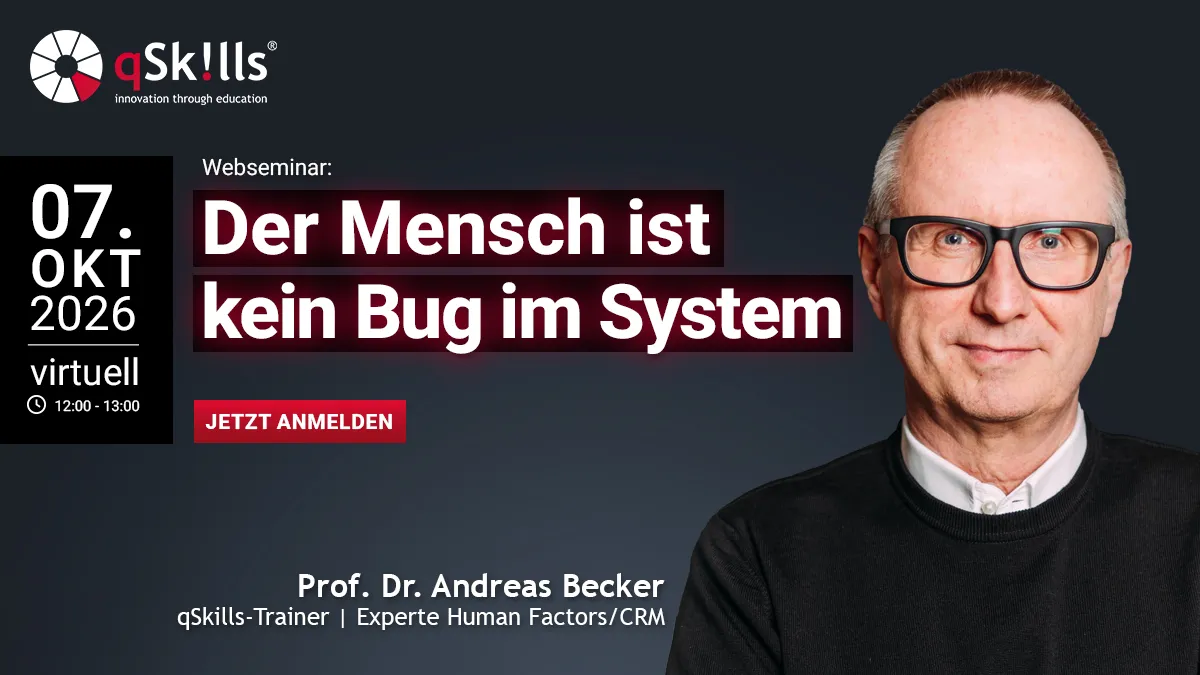
Webseminar | Humans are not a bug in the system: Human Factors, Human Performance, and non-technical skills in IT and Cybersecurity
Events & Webseminars 2026
In IT and cybersecurity, much attention is given to systems: architectures, interfaces, vulnerabilities, processes, attack vectors, monitoring, redundancy, and resilience. Rightly so. Yet one critical element of every system is sometimes treated a little too simplistically: people.
It is often implied that people simply need to pay closer attention, stay more focused, communicate more clearly, escalate issues earlier, and, ideally, avoid making mistakes altogether. That would certainly be nice. It would also be about as realistic as a permanently empty inbox, a ticketing system without follow-up questions, or a change implementation that unfolds exactly as planned.
This webseminar focuses on Human Factors in the day-to-day reality of IT and cybersecurity. Not only during crises. Not only during major incidents. Not only when everyone is posting in the same chat channel at once. Instead, it examines the situations where many problems actually begin: normal operations. Handovers. Routine activities. Assumptions. Small deviations. Data that exists but has not yet been transformed into a shared understanding of the situation.
The webseminar is built around three key ideas:
The human mind does not have unlimited bandwidth. Attention, working memory, and decision-making capabilities are powerful, but inherently limited.
Data alone does not create situational awareness. Systems provide information, but people and teams must turn that information into meaning, priorities, and effective action.
“Be more careful” is not a security strategy. Improving security requires more than appealing to individual behavior; it requires designing conditions that make effective behavior more likely.
The webseminar demonstrates why people are not the weak link, but rather a key safety and security factor in complex socio-technical systems. Topics include perception, communication, decision-making, teamwork, leadership, and how organizations can recognize earlier when conditions are beginning to deteriorate.
Grounded in research, practical in application, and offering one reassuring insight: humans are not a bug in the system. But sometimes they need a well-designed interface, too.
Date: 07.10.2026 | Time: 12:00 - 13:00
 Shopping cart
HF100-WS: Der Mensch ist kein Bug im System
was added to the shopping cart.
What will you learn?
How Human Factors influence performance, effectiveness, and safety in IT and cybersecurity teams.
Why attention, working memory, and decision-making have natural limitations - and how these limitations affect everyday work.
How data, alerts, and signals are transformed into a shared situational awareness that enables informed decision-making.
The role of communication, teamwork, leadership, and non-technical skills in building resilience and improving security.
What are the benefits?
A deeper understanding of how human factors can contribute to or help prevent risks.
Practical approaches for identifying and reducing sources of error in day-to-day operations.
Improved decision-making quality, even under time pressure, uncertainty, and complex conditions.
Ideas and insights on how organizations can create environments that make safe and effective behavior more likely.
What can you expect?
A practical perspective on the role of people within IT and cybersecurity organizations.
Illustrative examples from complex socio-technical systems, aviation, management, and information security.
New perspectives on topics such as perception, communication, escalation, collaboration, and leadership.
Evidence-based insights with direct relevance to the daily work of IT, cybersecurity, and management teams.
Who is this webseminar intended for?
IT and cybersecurity professionals who want to take a holistic approach to security.
Managers and team leaders in IT, operations, infrastructure, and information security.
Incident managers, SOC analysts, system administrators, and anyone responsible for making decisions in critical situations.
Quality, risk, and information security managers, as well as anyone interested in Human Factors and organizational resilience.
We look forward to your participation
Your qSkills™ Team
Shopping cart
HF100-WS: Der Mensch ist kein Bug im System
was added to the shopping cart.