

You are leaving our Website
Using an external Link:
You are now leaving our website. The following page is operated by a third party. We accept no responsibility for the content, data protection, or security of the linked page..
URL:
qSkills™ Security Summit 2026: Cyber Resilience in a World on Crisis Mode
News 2026
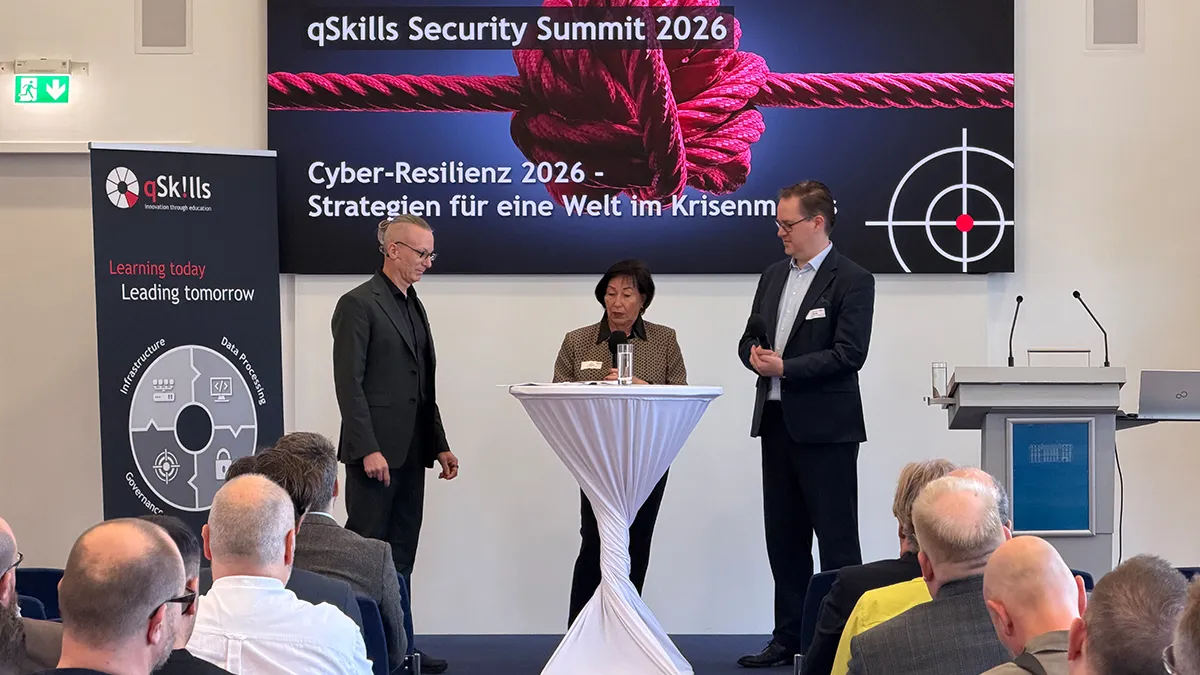
On October 26, 2026, the 19th qSkills™ Security Summit took place in Nuremberg. Under the guiding theme Cyber Resilience 2026 – Strategies for a World in Crisis Mode, experts, decision-makers, and IT security professionals came together to address current challenges in cybersecurity and develop new perspectives for practical application. They discussed emerging threat scenarios, AI, digital sovereignty, and the future of cybersecurity.
The focus was on the impact of geopolitical tensions, the growing importance of artificial intelligence, the security of global supply chains, and the protection of critical infrastructures. It became clear: Cybersecurity is no longer just a technical discipline. It requires strategic thinking, forward-looking action, and the ability to remain capable of action even under difficult conditions.
From geopolitical upheavals to digital sovereignty
The keynote speech was given by Jochen Werne with his presentation “A New Age of Enlightenment – Between Nuclear Missiles and Algorithms: Who Decides Our Future?”. He illustrated how AI, data, and technological dependencies are increasingly reshaping geopolitical power structures – and why responsible decision-making is becoming more important.
Prof. Dr. Dennis-Kenji Kipker, Research Director and Founder of cyberintelligence.institute, advocated for a shift from formal security based on checklists to lived cyber resilience. Companies must recognize threats early and secure their ability to act in a dynamic environment.
Supply chains and critical infrastructures in focus
Christian von der Schulenburg from Siemens Smart Infrastructure highlighted the challenges of supply chain security. The focus was on securing global supply chains and the question of how security, transparency, and efficiency can be reconciled.
Andreas Jambor, Central Information Security Officer at RWE Generation SE, addressed the protection of critical infrastructures. In addition to cyberattacks and sabotage, hybrid threats and drones are gaining importance. At the same time, requirements are increasing due to NIS-2, the CER Directive, and the KRITIS umbrella law.
Inés Engel addressed another future topic with Post-Quantum Cryptography (PQC). The scenario “Harvest Now, Decrypt Later” illustrates why companies should already consider their cryptographic future viability today and deal early with their PQC readiness.
Artificial intelligence: Opportunities, risks, and new attack surfaces
Dr. Arne Peter Raulf from the German Aerospace Center (DLR) classified the opportunities and risks of AI-supported vulnerability analyses. Despite increasing automation, human expertise and control remain crucial.
Arvid Rosinski, CISO at Audi AG, demonstrated through his own experiences how experimenting with agentic AI can create new applications in the IT security field. His message: Curiosity and the willingness to continuously learn will become important future skills.
The breakout sessions also offered practical insights: Janis Kinast live demonstrated what information about companies and their employees can be gathered from publicly available sources using OSINT. Barno Kaharova and Donald Ortmann explored the security risks of AI applications and possible protective measures in an interactive simulation.
Cyber vigilance and the human factor
Prof. Dr. Christian Hummert, Research Director at the Agency for Innovation in Cybersecurity, introduced the concept of cyber vigilance. It is about not only recognizing threats and reacting to attacks but also identifying risks as early as possible and proactively countering them.
The academic program concluded with a presentation by Prof. Dr. Andreas Becker titled “Clear Thinking in Crisis – Why Our Default Settings Are Faster Than Our Minds”. He explained how stress influences human decisions and why, especially in critical IT security situations, the ability to think clearly and act calmly is crucial.
Exchange, perspectives, and a shared look ahead
In addition to the professional input, the 19th qSkills™ Security Summit was shaped by personal conversations and exchanges among participants. The historic marble hall in the Gewerbemuseum provided the setting for discussions and new contacts. The program then took participants on exclusive thought tours to the Museum of the Future before the day concluded with a joint dinner at the Bootshaus am Dutzendteich.
Feedback from participants once again confirmed how valuable the combination of professional depth, diverse perspectives, and personal exchange is. Because cyber resilience is not created by technical solutions alone. It also thrives on knowledge, experience, collaboration, and the ability to adapt to new challenges.
On October 4, 2027, we will jointly celebrate the 20th qSkills™ Security Summit. We look forward to bringing together many experts and decision-makers once again, setting new impulses, and continuing the dialogue on the future of cybersecurity.
For more information and impressions of the qSkills™ Security Summit, visit our event website.